Product Rendering for a Tile Brand: the Waxman Ceramics Case Study
35 colourways, 17 interiors and dozens of texture iterations to capture the hardest thing in ceramic rendering: the unique character of every handmade tile. Here is how we produced product renders for Waxman Ceramics, a UK distributor of premium ceramics.
About the Client, the Scope and the Renders
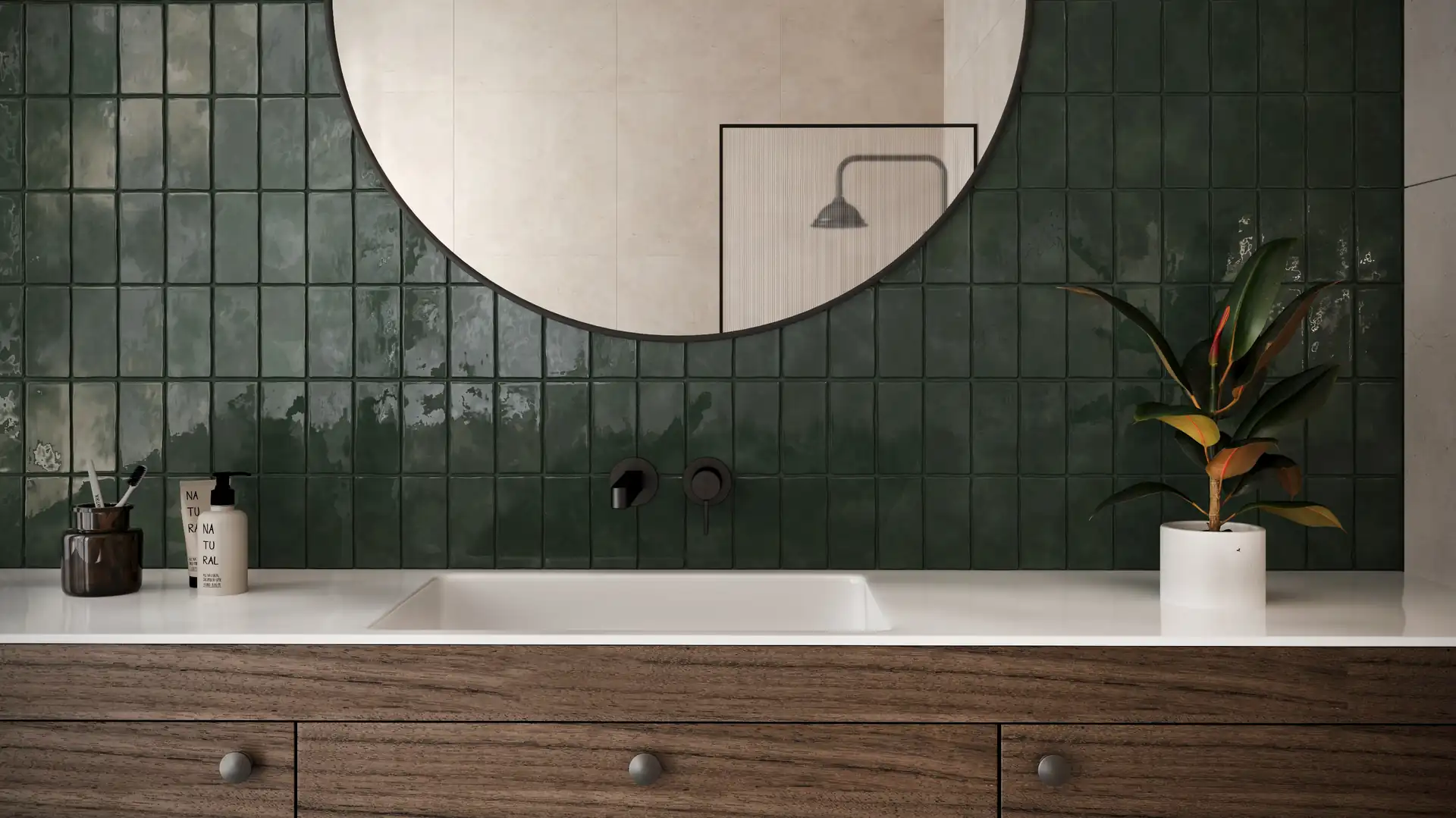
Waxman Ceramics is a UK distributor of ceramic tiles with a wide range of handmade-style products: tiles that are deliberately imperfect. Each one is slightly different, with a different shape, shade and surface texture. That irregularity is their greatest asset and, at the same time, the biggest challenge for a visualisation studio.
The project covered 17 interiors, mainly bathrooms and kitchens, with several colourways for each. In total we produced around 35 tile colourways, each needing its own set of textures. Same shot, same interior, different tiles: it sounds simple. In practice it meant many weeks of intensive work.

Two Ways to Render Tiles: 3D Modelling vs a PBR Material
When rendering products for ceramic tile and finishing material brands, a studio always faces a fundamental technical choice.
The first route is modelling each tile in 3D and creating its variants. The right modifiers can speed this up and avoid moving every vertex by hand, but with many variants and formats it is time-consuming and hard to scale.
The second route is creating a PBR material: a set of special texture maps, each responsible for a particular surface property. The diffuse map defines colour and pattern, roughness controls gloss and matt areas, bump and normal maps reproduce fine surface detail without adding polygons, and the displacement map adds real bumps and hollows that change the mesh geometry. Together these five maps form a complete description of the material, which the render engine turns into a photorealistic surface.
We chose the PBR route, and it was the right call, even if a demanding one.

Rendering Building Materials: How to Reproduce a Handmade Texture in 3D
This is the heart of the project and what separates a professional product rendering studio from one that relies solely on ready-made assets.
When rendering building and finishing materials such as ceramic tiles, natural stone, brick or concrete, a studio faces a question that decides the quality of the whole project: where does the texture come from? For most projects, stock assets are enough. But when a render has to present a specific product from a specific manufacturer, a ready-made asset will never capture its unique character. Waxman tiles are handmade, so we had to create the PBR material from scratch.
The key challenge was creating a tileable texture: a map covering a layout of 225 tiles, built so that it forms a continuous pattern with no visible seams when repeated. Within it, each of the 225 tiles needed its own shape and shade, with differences subtle but noticeable. Getting the balance right was the hardest part. Too much variation looked artificial, like a rendering error rather than craftsmanship. Too little made the tiles look mass-produced and lose their character. Every map had to match the others perfectly: every irregularity in the displacement map had to be reflected in the normal and roughness maps. With two tile formats, square and rectangular, that meant 10 PBR maps to create and keep in sync.

Everything was based on photos supplied by the client. Product photos often don’t fully capture the true colour of ceramics, especially subtle shades and surface gloss, which meant further iterations. For some colourways we went through several versions before the result faithfully matched the original product. Tools such as InstaMat speed up work on textures like these considerably, but mastering the tool isn’t enough: creating your own PBR materials from scratch takes a deep understanding of the physics of light and the properties of materials. Many 3D artists rely entirely on ready-made assets from the internet, and that works well when a render only needs to show something generic. When a render has to present a specific product from a specific manufacturer, you need textures that fully capture the nature of that product.

Interiors Designed for the UK Market
The technical texture challenge was one side of the project. The other was designing the interiors themselves.
Every market has its own architectural and aesthetic character. Interior renders created for a client in a particular country should reflect that market: the proportions of the spaces, typical room layouts and characteristic fixtures and fittings.
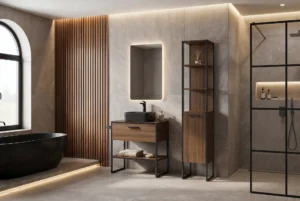
We designed every interior with that in mind. We researched the most common layouts in British bathrooms and kitchens: where the fittings go, the proportions of the rooms and the typical fixtures. The idea was that a British customer looking at the render would think “that looks like my bathroom”, not a hotel or a holiday apartment. At the same time, the interior had to be beautiful, polished and inspiring, because its job is to sell tiles.
Balancing the realism of a small space with visual appeal was a design challenge in its own right. It took many framing iterations to avoid a cramped feel while keeping an interesting composition and the sense of looking at a real bathroom rather than a showroom.
The Result: Product Renders Working on the Website and Social Media
The finished renders went onto the Waxman Ceramics website and the brand’s social media channels, where they serve as sales and marketing material. 35 colourways shown in realistic interiors give end customers exactly what they need before buying: the chance to see how a particular tile will look in a real space.
For Waxman Ceramics the alternative would have been a photo shoot: building a set for each interior and photographing every colourway separately. With 35 colourways and 17 interiors, the cost and time of that production would have been many times higher than 3D rendering. And every change to the collection would mean repeating the whole process. The finished PBR material we created can be applied to a new wall in a new interior in minutes.


Product Rendering for Finishing Material Brands: When It Makes Sense
This project shows when 3D rendering stops being an alternative to a photo shoot and becomes the only sensible option.
If your product comes in many colours, textures or patterns, 3D rendering lets you show every one without making physical samples or organising separate shoots. If your product is handmade or has an irregular structure, a professional PBR texture will capture that better than standard product photography. If you sell in a particular market, we can tailor the renders to that market’s culture and taste.
We create product renders for manufacturers of ceramic tiles, flooring, and building and finishing materials. If you have a product you want to show in a real setting,